NASA Perseverance Rover Makes Historic Mars Journey via AI-Planned Routes
NASA’s Perseverance rover just took a historic leap for interplanetary exploration. The rover successfully navigated the rugged, wheel-shredding terrain of Jezero Crater using routes planned entirely by Anthropic’s Claude AI.
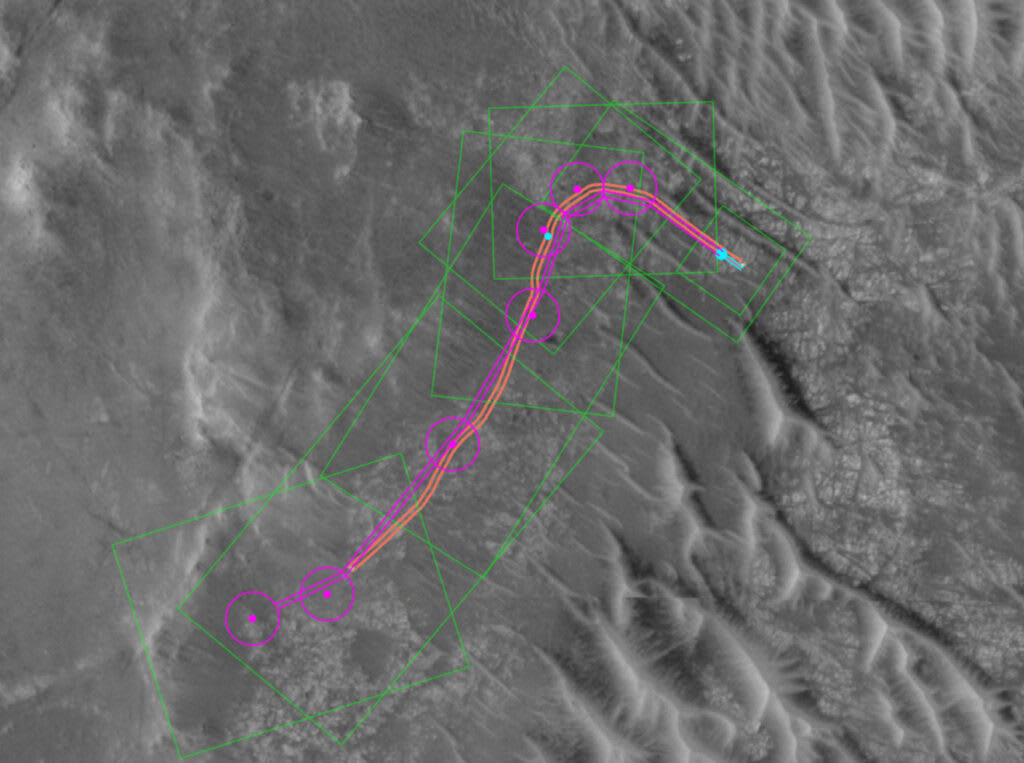
On December 8 and 10, 2025, Perseverance crunched across 456 meters of alien rock and sand. The waypoints (the digital breadcrumbs the rover follows) were generated by an AI that “studied” the terrain from orbit.
It Looks Like AI Has a Future in Space
NASA has sent six rovers to Mars. Two are still active: Curiosity, which arrived in 2012, and Perseverance, which touched down in 2021. Driving these multi-billion dollar machines is a high-stakes game. Since 1997, human “drivers” at the Jet Propulsion Laboratory (JPL) have spent grueling hours squinting at Martian rocks to plot paths 140 million miles away. One wrong click could beach a rover in a sand trap or tip it over a jagged outcrop.
Perseverance is currently climbing the rim of Jezero Crater, an ancient delta where water once flowed. The terrain is a nightmare of “sand ripples” and jagged bedrock. Usually, humans plan these routes in 100-meter chunks.
Open the Youtube video
In December, the team handed the keys to Claude — mostly.
Using high-resolution imagery from the Mars Reconnaissance Orbiter, the AI analyzed the bedrock and boulder fields. It processed the same data humans use, but it worked faster, stringing together ten-meter segments into a continuous, safe path.
NASA engineers didn’t just take the AI’s word for it. They ran every suggested command through a “digital twin” — a high-fidelity virtual replica of Perseverance. They checked over 500,000 variables. The AI passed with flying colors. NASA only made “minor changes” to the final route, mainly because the human team had access to ground-level photos the AI hadn’t seen yet.
NASA Is Under Pressure
The results speak for themselves. On December 8, the AI-guided rover covered 210 meters. Two days later, it knocked out another 246 meters.
“This demonstration shows how far our capabilities have advanced and broadens how we will explore other worlds,” said NASA Administrator Jared Isaacman. “Autonomous technologies like this can help missions to operate more efficiently, respond to challenging terrain, and increase science return as distance from Earth grows. It’s a strong example of teams applying new technology carefully and responsibly in real operations.”
Open the Youtube video
This wasn’t just a flex or a “let’s try AI and see what happens” moment. NASA is constantly being asked to do more with less. The agency has to return to the Moon, prep for Mars, explore the icy moons of Jupiter, all with a workforce that has been trimmed by budget cuts and political shifts. Last year, the agency lost roughly 20% of its staff. The Trump administration is constantly looking to cut NASA’s budget. We have fewer “drivers” than ever, but the science goals are getting more ambitious.
By incorporating AI to handle the “tedious manual planning,” JPL engineers estimate they can cut route-planning time in half. This should enable the engineers who are left to focus more on answering the tough questions rather than the day-to-day planning.
Just the Beginning
NASA also envisions this technology being deployed even more in future missions.
“Imagine intelligent systems not only on the ground at Earth, but also in edge applications in our rovers, helicopters, drones, and other surface elements trained with the collective wisdom of our NASA engineers, scientists, and astronauts,” said Matt Wallace, manager of JPL’s Exploration Systems Office. “That is the game-changing technology we need to establish the infrastructure and systems required for a permanent human presence on the Moon and take the U.S. to Mars and beyond.”
It’s yet another testament to the technology’s stunning progress.
Just a couple of years ago, AI models struggled to navigate the 8-bit obstacles of a Pokémon game. Today, they are charting the course for humanity’s most advanced laboratory on a frozen desert world.
Who knows what will come next?


Leave a Reply