The Secret Sky: Particle Accelerator Reveals Ancient Greek Star Map
The Legacy of Ancient Greek Astronomy
Ancient Greek astronomers made significant contributions to our understanding of the night sky long before the invention of the telescope in the 1600s. These early scientists relied solely on their naked eyes to observe and document celestial phenomena. One of the most notable figures in this field was Hipparchus, a Greek astronomer who created a detailed star catalog based on his observations. For many years, it was believed that this important work had been lost to history. However, a hidden copy of his catalog survived for centuries, buried within a medieval manuscript.
This hidden text was found in a document known as the Codex Climaci Rescriptus, a palimpsest that dates back to the fifth to tenth centuries C.E. A palimpsest is a manuscript that has been erased and overwritten with new text, a common practice in ancient times due to the high cost of parchment. Despite being overwritten, the older text often holds greater historical value, and scientists have long sought ways to recover it.
The Discovery of Hidden Text
In 2021, a team of researchers became interested in the Codex Climaci Rescriptus after discovering constellation names and measurements linked to Hipparchus’ work. These details were hidden beneath layers of other text, making them nearly impossible to read using traditional methods. Victor Gysembergh, a researcher at the French National Center for Scientific Research (CNRS), described the importance of this discovery: “Since this star catalog is so important for understanding the birth of science, it made us want to pull out all the stops.”
The team turned to an advanced technique involving a particle accelerator known as a synchrotron. This technology has proven to be one of the most effective methods for revealing erased ancient texts. In a recent interview with Scientific American, Gysembergh noted, “What we’ve been seeing is amazing in comparison to previous imaging.”
How the Synchrotron Works
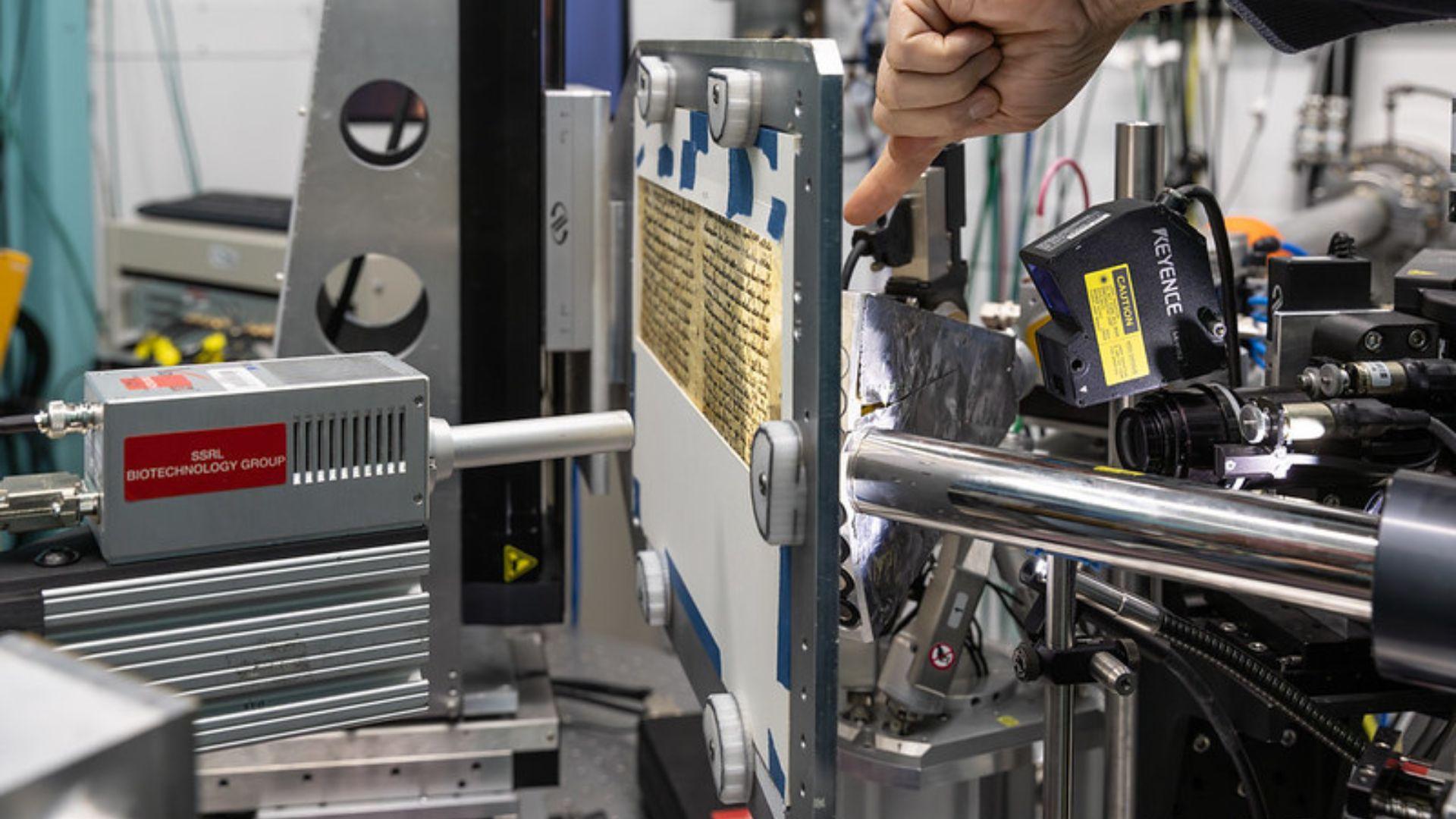
The synchrotron used by the researchers is located at the SLAC National Accelerator Laboratory in Menlo Park, California. This powerful machine accelerates charged particles to nearly the speed of light, causing them to emit bright beams of X-ray light. These X-rays can create extremely detailed images of objects, allowing scientists to see through layers of text.
The team used this technique to examine the Codex Climaci Rescriptus. The X-ray beams interacted differently with the inks used in different eras, either scattering, diffracting, or being absorbed. By focusing on the ink used for Hipparchus’s catalog, which was significantly older than the overlying text, the researchers were able to detect a calcium-rich residue that helped map out the hidden text.
Future Implications
The discovery of this hidden text marks a major breakthrough in the study of ancient astronomy. Once the analysis is complete, the Codex Climaci Rescriptus is expected to provide the most comprehensive historical sample of Hipparchus’s observations. This could offer valuable insights into the methods and knowledge of ancient Greek astronomers, shedding light on the origins of scientific inquiry.
The use of advanced technologies like the synchrotron demonstrates how modern science can uncover the secrets of the past. As researchers continue to analyze the data, they hope to unlock even more information about the stars and the people who first mapped them. This work not only preserves historical knowledge but also inspires future generations to explore the mysteries of the universe.




Leave a Reply