Mysterious Connecticut Sounds Inspired a Lovecraft Tale

The Enigma of the Moodus Noises
The Moodus Noises remain one of the most unsettling natural mysteries in the United States. For over three centuries, residents of a small village in south-central Connecticut have reported strange, unexplained sounds rising from beneath the earth: booming, rumbling, cracking noises that come without warning and vanish just as suddenly. No one has ever fully explained them. And in a world where almost everything can be looked up, googled, and debunked in seconds, that silence from science is itself a kind of horror.
It was only a matter of time (even if it took centuries) for these noises to capture the imagination of an intense creative mind. And, as it happened, it was no less than one of the most haunting and intriguing chroniclers of New England, H.P. Lovecraft. But before Lovecraft was even born, the spectre of the Moodus Noises hung over many generations.
The village of Moodus is nestled inside the town of East Haddam and gets its name from the Wangunk people, who called the area Machemoodus: roughly, “place of bad noises.” They believed the sounds came from a god named Hobomoko, who sat on a sapphire throne deep beneath Mount Tom. When English Puritan settlers arrived in the 1600s, they offered their own explanation: the Devil himself was stirring underground. The first written record of the noises dates to 1702, and by 1729, Reverend Stephen Hosmer of East Haddam wrote to a friend in Boston describing sounds that frightened the entire community. “I have myself heard eight or ten sounds successively,” he wrote, “imitating small arms, in the space of five minutes.”
Hosmer had heard hundreds of them over twenty years. Sometimes they sounded like distant thunder. Sometimes like pistol shots fired beneath the ground. The noises disappeared for stretches, sometimes for years, then returned with a fury. In 1760, legend has it that King George sent an alchemist named Dr. Steele to Connecticut to silence them. Steele sealed himself inside a blacksmith’s shop, covered the windows, and worked in secrecy for weeks. One night, townsfolk saw flames and sparks erupting from the building. The next morning, Steele announced he had extracted a giant carbuncle—a glowing gemstone—from the bowels of the earth, and that the noises would stop.
They did, for a while. Then, inevitably, they came back. Whether Dr. Steele was a fraud or something stranger, the story captured the imagination of a region already soaked in witch trials and colonial dread.

The largest seismic event in Connecticut’s recorded history occurred in Moodus on May 16, 1791. The quake measured between 4.5 and 5 on the Richter scale, toppled chimneys and stone walls, and sent fish leaping out of water twenty miles away. Tremors continued for days. It was, by any measure, terrifying. And yet even after science eventually identified the cause—shallow micro-earthquakes in unusually brittle rock, amplified by underground fractures—a nagging mystery remained.
Robert Thorson, an earth sciences professor at the University of Connecticut, put it plainly: “There is something about Moodus that is tectonic that is creating these noises. And then there is something acoustic that is amplifying or modifying the noises. We don’t really have a good answer for the cause of either.”
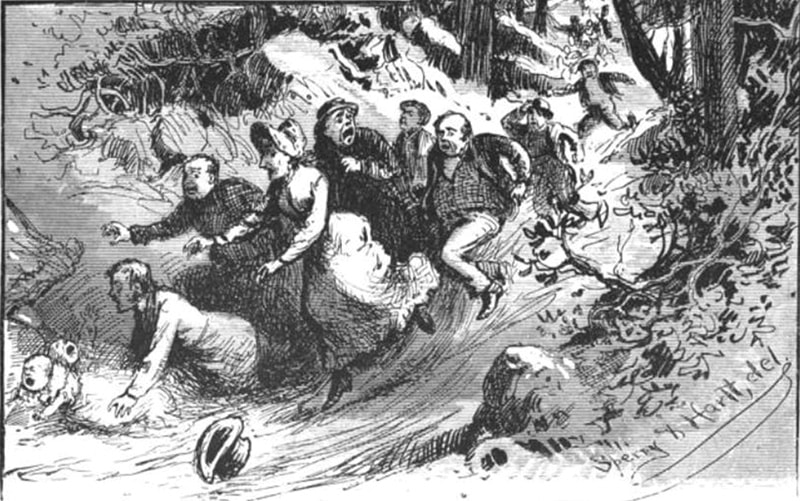
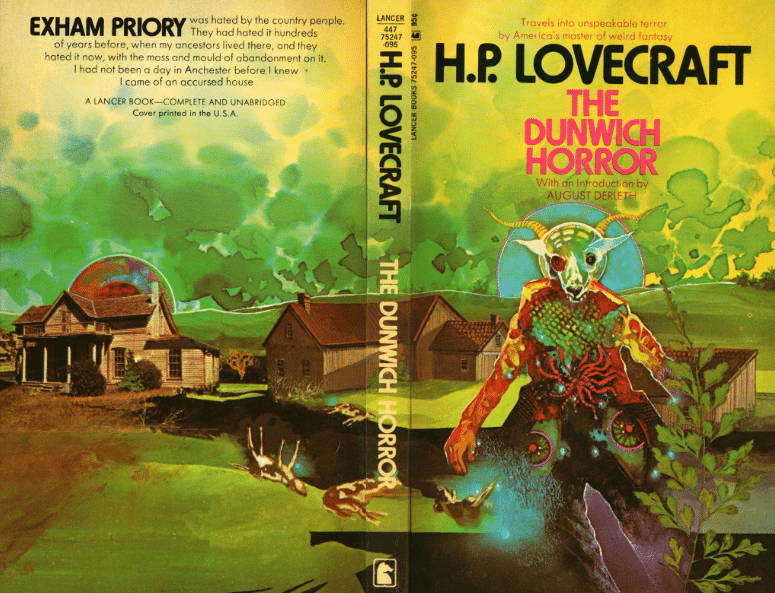
It was into this landscape of ancient dread and unanswered questions that H.P. Lovecraft reached when he wrote The Dunwich Horror in 1928. The story, set in a decaying fictional Massachusetts village, opens with mysterious sounds echoing from the hills, sounds that terrorize locals and that no authority can explain or silence.
East Haddam and the Moodus region were a direct influence on the story’s atmosphere, alongside the nearby Devil’s Hopyard, a real place with its own dark folklore. The book Myths and Legends of Our Own Land, by Charles M. Skinner—which Lovecraft appears to have read—describes both the Devil’s Hopyard and the Moodus Noises in detail.
What Lovecraft understood instinctively is something that still holds true: unexplained phenomena tend to stay with us. They become the architecture of our myths, the raw material from which stories about evil and the unknowable are built. Lovecraft simply did what horror writers have always done with real mysteries. He listened, and then he wrote down what he heard.
The noises have not stopped. As recently as March 2024, another boom rattled the village of East Haddam, and residents reported it on social media with a mixture of humor and unease. The local high school sports teams are even nicknamed the “Noises.” But beneath the jokes, something older persists: the knowledge that the earth beneath Moodus has a voice, and that for three hundred years, no one has been able to silence it.

- IDI Riau Buka Kesempatan Diskusi Dokter RSUD Tengku Rafian Siak tentang Kesetaraan Gaji - March 30, 2026
- Your Core Routine Is Incomplete Without These Oblique Exercises - March 30, 2026
- Mengapa Lutut Saya Memar Akibat Berlari? - March 30, 2026



Leave a Reply