Vitamin A’s Hidden Threat: Sabotaging the Body’s Cancer Defense
Understanding the Role of Retinoic Acid in Cancer
Scientists at the Princeton University Branch of the Ludwig Institute for Cancer Research have uncovered new mechanisms through which a metabolic derivative of vitamin A, all-trans retinoic acid, affects the body’s anti-cancer immune response and the effectiveness of certain cancer vaccines. Their findings, published in two separate studies, shed light on this complex relationship and offer potential pathways for future treatments.
The Controversial Role of Vitamin A Metabolites
Retinoids, which are metabolites of vitamin A, have long been a subject of debate in health and disease. These studies aim to clarify their role and introduce candidate drugs that can block the biochemical signaling pathways they activate within cells.
One study, published in Nature Immunology and led by Cao Fang from the Ludwig Princeton branch, explores how retinoic acid produced by dendritic cells (DCs) alters them to induce a dangerous tolerance of tumors. This tolerance reduces the effectiveness of dendritic cell vaccines, which are designed to stimulate an immune response against cancer.
The researchers also developed a compound called KyA33, which inhibits retinoic acid production by both cancer cells and DCs. This compound not only enhances the efficacy of DC vaccines in preclinical studies but also shows promise as an independent cancer immunotherapy.
Designing Effective Drugs to Target Retinoic Acid
The second study, led by Mark Esposito, a former graduate student in Kang’s lab, describes the development of drugs that inhibit retinoic acid production. Despite being known to scientists for over a century, efforts to create viable drugs to block their signaling have largely failed. This study provides a blueprint for the design of KyA33, offering insights into drug discovery.
“Taken together, our findings reveal the broad influence retinoic acid has in attenuating vitally important immune responses to cancer,” said Kang. “In exploring this phenomenon, we also solved a longstanding challenge in pharmacology by developing safe and selective inhibitors of retinoic acid signaling and established preclinical proof of concept for their use in cancer immunotherapy.”
The Deadly Tolerance Mechanism
Retinoic acid is produced by an enzyme known as ALDH1a3, which is often overexpressed in human cancer cells, or by its sibling ALDH1a2 in certain subtypes of DCs. The molecule activates a receptor in the cell’s nucleus to initiate a molecular signaling cascade that alters gene expression.
While retinoic acid’s role in inducing regulatory T cells (Tregs) in the gut is well-known, its effect on DCs themselves was less understood. DCs play a critical role in orchestrating protective immune responses. They patrol the body looking for signs of infection and cancer, processing and presenting antigens to activate T cells.
DC cancer vaccines are typically produced by generating DCs from their precursors in the blood. However, these vaccines often do not perform as expected. Fang, Kang, and colleagues discovered that under conditions used to produce DC vaccines, differentiating dendritic cells begin expressing ALDH1a2, producing high levels of retinoic acid. This suppresses DC maturation, diminishing the ability of these cells to trigger anti-tumor immunity.
To make matters worse, the retinoic acid secreted by DCs also favors the development of macrophages that are less efficient than DCs in combating cancer cells. The accumulation of these cells instead of DCs further undermines the efficacy of DC vaccines.
Resolving an Old Paradox
The development of these ALDH1a2/3 inhibitors is a significant achievement. Of the dozen classic nuclear receptor signaling pathways, the one activated by retinoic acid was the first such pathway discovered but remains the only one that has not yet been successfully targeted by a drug.
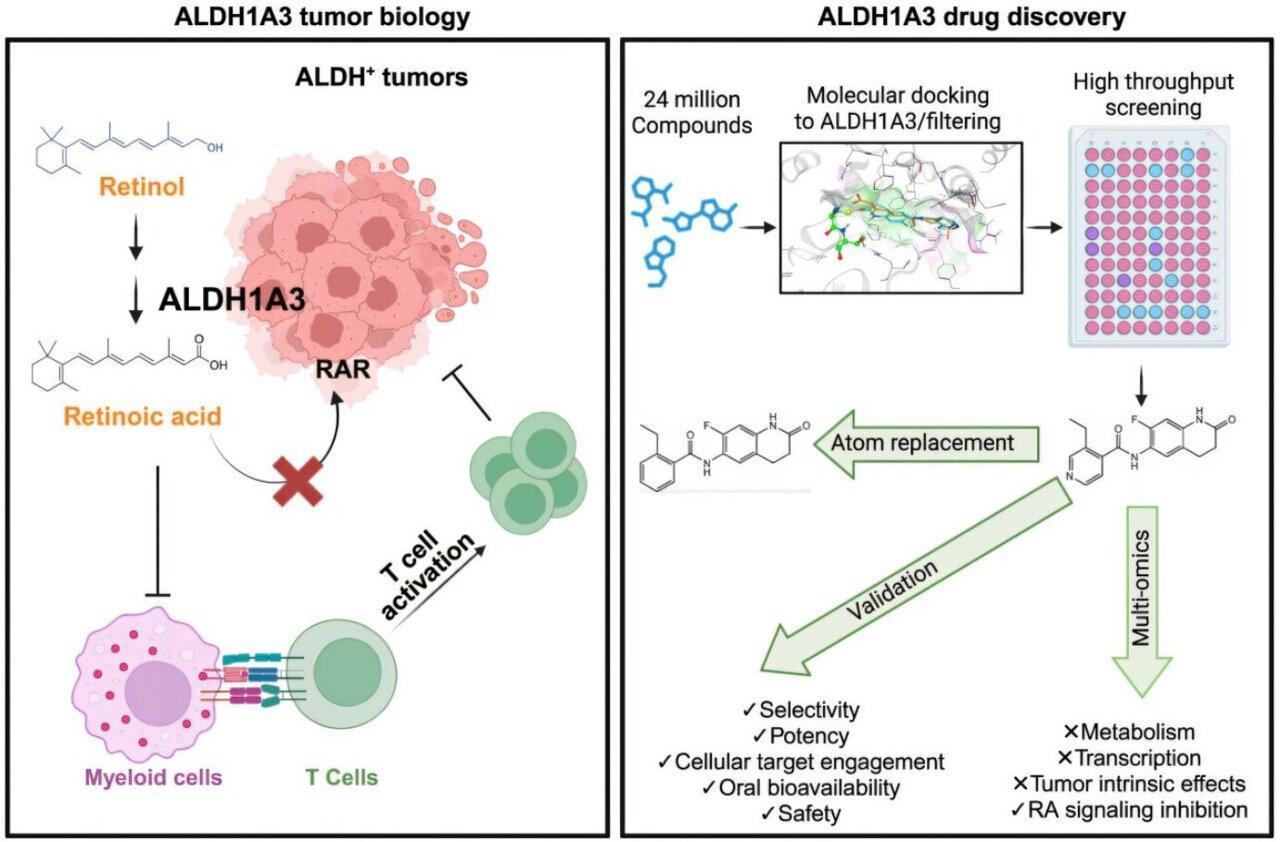
The iScience paper describes a hybrid computational and large-scale drug screening approach taken by Esposito, Kang, and colleagues to develop their inhibitors. With the unique tool offered by these novel compounds, the researchers were able to solve the apparent paradox of retinoid nuclear signaling in cancer.
Retinoic acid has been shown to induce the growth arrest and death of cancer cells in laboratory cell cultures, a finding that has imbued vitamin A with anti-cancer agency in the popular imagination. On the other hand, multiple lines of evidence, including the findings of major clinical trials, indicate that high intake of vitamin A actually increases the incidence of cancer and related mortality. Moreover, elevated expression of ALDH1A enzymes in tumors is associated with poor survival across multiple types of cancer.
“Our study reveals the mechanistic basis for this paradox,” said Esposito. “We’ve shown that ALDH1a3 is overexpressed in diverse cancers to generate retinoic acid, but that cancer cells lose their responsiveness to retinoid receptor signaling, avoiding its potential anti-proliferative or differentiating effects. This explains, in part, the paradox of vitamin A’s effects on cancer growth.”
The other part, Esposito, Kang, and colleagues found, is that retinoic acid does not influence the cancer cells themselves but is rather secreted into the tumor microenvironment to suppress the anti-cancer immune response. One way it does so is by disrupting T cell responses to cancer.
To demonstrate this, the researchers showed that these novel ALDH1a3 inhibitors serve as a potent immunotherapy in mouse models of cancer by stimulating the immune system to attack tumors.
“By developing candidate drugs that safely and specifically inhibit nuclear signaling through the retinoic acid pathway, we are paving the way for a novel therapeutic approach to cancer,” said Kang.

- Lars Nootbaar Out for 2026; Who Steps In? - April 3, 2026
- Seniman Tejano pemenang Latin Grammy David Lee Garza dirawat di rumah sakit di San Antonio - April 3, 2026
- Kunci Jawaban Bahasa Indonesia Kelas 5 Halaman 180 Bab 8 - April 3, 2026



Leave a Reply