Black hole growth hits record speed after Big Bang—now 100 million suns’ worth of mass
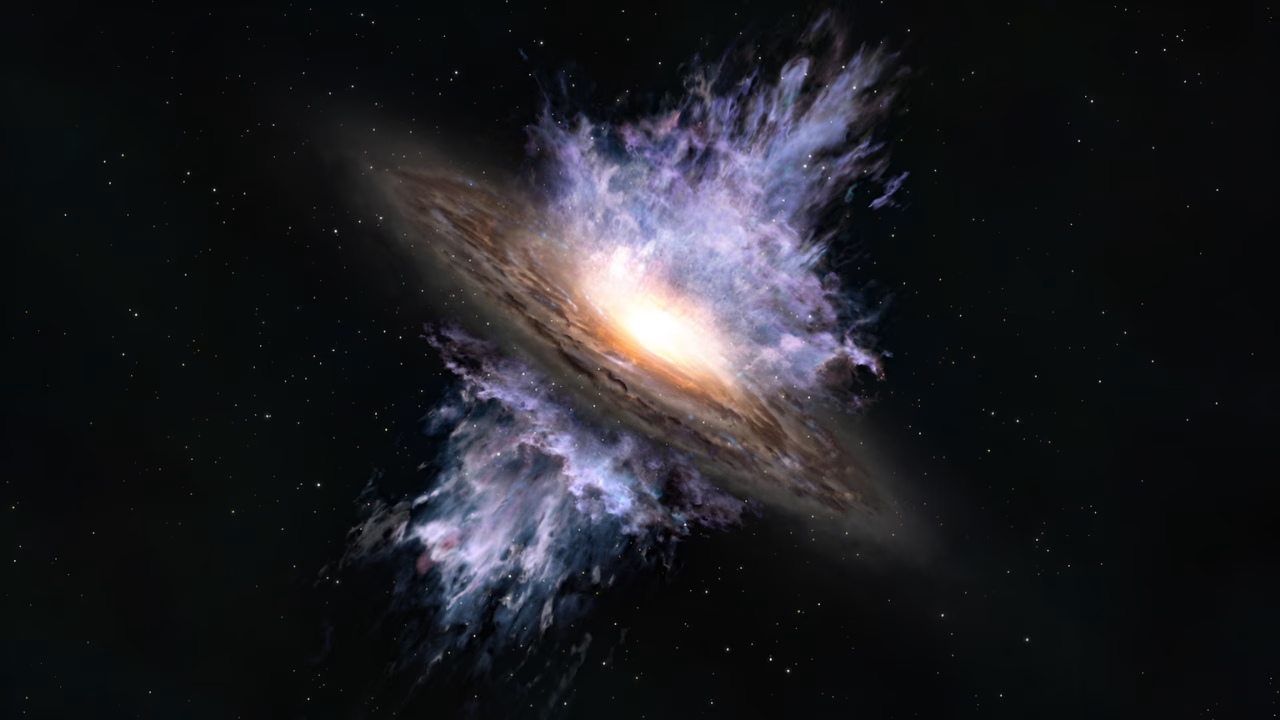

Just 570 million years after the Big Bang, a young, compact galaxy named CANUCS-LRD-z8.6 appears to host a supermassive black hole that is growing far faster than theory allows. Using the James Webb Space Telescope (JWST), astronomers have found signs that this black hole is feeding so rapidly that it already outweighs what models would predict for such a small, early galaxy, forcing a rethink of how black holes and galaxies formed in the infant universe.
Runaway Growth in a Primitive Galaxy

In most nearby systems, the mass of a central black hole is closely linked to the mass of the surrounding galaxy. As stars form and galaxies gain material, their black holes grow in step, leading to a relatively tight relationship between the two. In CANUCS-LRD-z8.6, however, that balance appears to break down.
The black hole’s mass, inferred from its intense radiation and the rate at which it is drawing in gas, is disproportionately large compared with the modest stellar mass of its host. Instead of keeping pace, the black hole seems to be advancing far ahead, accumulating matter at a rate that outstrips the galaxy’s own star formation.
For researchers, that imbalance suggests that, at least in some corners of the young cosmos, black holes may have followed a separate growth track from the galaxies around them.
Little Red Dot With An Outsized Engine

CANUCS-LRD-z8.6 belongs to a curious class of objects astronomers call “Little Red Dots” – faint, distant, and physically small galaxies that often appear as tiny reddish specks in JWST images. The red color reflects both their great distance and the properties of the light emerging from them.
These compact systems were not expected to harbor very large black holes. Their small size and youth implied limited time and material for any central object to grow. Finding a rapidly feeding supermassive black hole in such a galaxy pushes directly against that expectation.
The host itself still carries the imprint of a very early epoch. It is dense and relatively poor in heavy elements, a chemical fingerprint of a galaxy that has only recently begun forming stars. In that kind of environment, standard models say there has not been enough time to build up a massive black hole through steady accretion alone, hinting either at an unusually massive “seed” black hole at birth or at growth episodes more extreme than normally assumed.
What JWST Is Seeing At The Core

JWST’s sensitive instruments picked up highly ionized gas in the region surrounding the black hole, a clear sign that it is actively accreting material. As gas falls inward, it heats up and emits energetic radiation that strips electrons from atoms, leaving behind ionized gas that telescopes can detect across vast distances.
The strength and character of this emission reveal that the black hole is feeding at an extraordinary pace. Its inferred accretion rate is not only high in absolute terms, but also significantly higher than the rate at which the host galaxy is forming new stars. That contrast implies that, during this phase at least, the central black hole is gaining mass much faster than the rest of the galaxy is building up its stellar population.
This behavior conflicts with the long-standing picture in which the growth of galaxies and black holes is tightly coupled by feedback: as black holes feed, they heat and stir the surrounding gas, regulating both their own development and the formation of new stars. In CANUCS-LRD-z8.6, that feedback relationship may be operating differently, or on timescales not yet captured by current models.
Rewriting The Early Growth Playbook
The discovery has broader consequences for theories of how structure emerged in the early universe. For years, one puzzle has been how supermassive black holes, with masses millions to billions of times that of the Sun, managed to appear less than a billion years after the Big Bang. Standard scenarios, in which black holes form from the collapse of massive stars and then grow steadily, struggle to reach such sizes so quickly.
An overmassive black hole in a tiny, chemically primitive galaxy offers direct evidence that, at very early times, the balance may have tilted in favor of the black holes. Instead of galaxies and black holes growing together, some black holes might have raced ahead, powered by brief but intense episodes of accretion.
That possibility points to alternative formation paths, such as the direct collapse of massive gas clouds into large black hole “seeds,” or repeated periods of near-maximal feeding that allow black holes to leapfrog typical growth limits. It also suggests that the relationship observed today between galaxy mass and black hole mass may have been built up over time rather than present from the start.
What Astronomers Will Look For Next

The team behind the discovery, including lead author Roberta Tripodi and collaborators such as researchers at the University of Ljubljana, now aims to determine whether CANUCS-LRD-z8.6 is an outlier or a sign of a wider pattern. With JWST continuing its surveys, astronomers are combing the distant universe for more Little Red Dots hosting similarly overmassive black holes.
If many such systems are found, they could mark a common phase in early cosmic history, when black holes often outgrew their host galaxies. That, in turn, would require significant revisions to models of galaxy assembly, star formation, and black hole feedback.
Beyond reshaping technical theories, the work broadens the picture of what the first few hundred million years after the Big Bang might have been like. Instead of a gently building cosmos, the early universe may have been a more chaotic environment where some black holes gained mass with extreme speed, reshaping their surroundings in ways still visible across time.
As new observations come in, scientists hope to pin down the physical mechanisms that allowed such rapid growth and to map how these early black holes influenced the galaxies that later evolved into the large systems seen today. The case of CANUCS-LRD-z8.6 suggests that the next wave of discoveries may further change how both researchers and the wider public understand the universe’s beginnings and our evolving place within it.
Sources:
Nature Communications, November 2025 — “Extreme properties of a compact and massive accreting supermassive black hole at z=8.6”
ESA Webb Official News Release (WEIC2522), November 18, 2025
NASA Science Portal — Black Hole Existed 570 Million Years After Big Bang
Universe Today, November 18, 2025 — “The JWST Makes Some Headway Understanding Little Red Dots”
Space.com, November 20, 2025 — “James Webb Space Telescope spots rapidly feeding supermassive black hole in the infancy of the universe”
NASA Spaceflight.com, November 22, 2025 — “Webb discovers rapidly growing black hole in the very early universe”

- Wadahi Bakat Atlet Menembak, Yogyakarta Siap Miliki Mini Stadion Tembakan Dalam Ruang - March 19, 2026
- Pengobatan mussel quagga sedang berlangsung di Twin Falls - March 19, 2026
- BlueCross Healthy Place bersiap untuk peresmian Founder’s Park - March 19, 2026
Leave a Reply