Trump signs an order to end Biden-era fuel standards
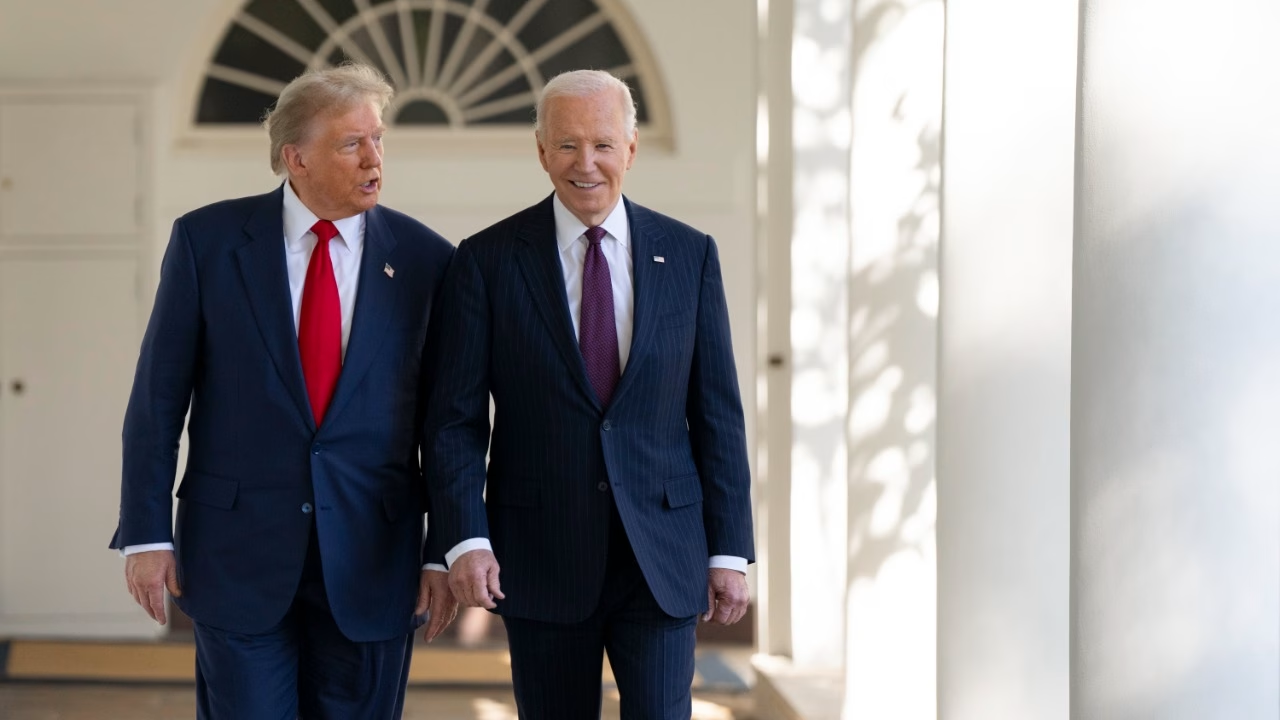
President Donald Trump has signed an order that dismantles the Biden-era push for steadily tougher fuel economy rules, resetting the trajectory for how efficiently new cars and trucks must use gasoline. The move replaces a climate-focused framework with one centered on consumer choice and industry flexibility, while locking in a slower pace of improvement for the next decade.
The decision marks a defining moment in the fight over how quickly The US should move away from gasoline-powered vehicles, and it caps months of signals from the White House that Biden’s standards were on borrowed time. It also raises immediate questions about how automakers, regulators and climate advocates will navigate a looser regime that still has to coexist with state-level ambitions and global emissions targets.
What Trump’s order actually does to Biden’s fuel rules
At its core, the new directive instructs federal regulators to unwind the Biden blueprint that would have sharply increased average mileage requirements for new vehicles through the early 2030s. Under that earlier plan, automakers were expected to keep raising efficiency so that the fleet-wide target climbed toward roughly 50 mpg by the 2031 model year, a trajectory that was designed to cut planet-warming pollution and accelerate the shift to cleaner technology. Trump’s order instead tells agencies to finalize a weaker standard that slows the annual gains and gives manufacturers more room to keep selling larger, less efficient models without facing the same regulatory squeeze that Biden had envisioned.
The clearest signal of that shift is the new Trump administration proposal to lower the 2031 requirement to 34.5 m for the fleet, a figure that dramatically undercuts the Biden-era ambition. That change is paired with a broader rollback of the fuel economy rules that had been expected to keep raising efficiency by about 2% per year, a pace that had been baked into planning across The US auto sector and that is now being reset by Trump’s order to end Biden’s approach to fuel standards.
A capstone to Trump’s broader assault on EV and climate policy
Trump’s decision on fuel economy does not stand alone, it caps a broader strategy to slow the transition away from gasoline-powered vehicles and to reframe climate policy as a threat to affordability. The White House has already moved to pare back electric vehicle mandates and soften emissions rules, and this latest step on mileage standards is described by allies as the final piece in a campaign to ease pressure on traditional engines. In that context, the order functions as both a regulatory change and a political statement that the administration is more interested in preserving the current market for trucks and SUVs than in chasing aggressive decarbonization targets.
That broader pattern is evident in the way Trump has capped his EV assault with a fuel economy repeal that is explicitly billed as the latest move aimed at slowing the transition away from gasoline-powered vehicles, with the president directing agencies to relax limits on cars and trucks that had been tightened under Biden. The new order fits squarely within that agenda, as described in reporting that details how Trump caps EV assault by rolling back the very limits that were supposed to push the industry toward cleaner models.
How the rollback reshapes automaker incentives
For automakers, the order is both a reprieve and a new source of uncertainty. Companies that had braced for steep annual gains in required mileage now face a looser standard that lets them keep selling profitable pickups and large SUVs without racing as quickly into electric or ultra-efficient models. That shift reduces the immediate compliance burden and may ease short-term costs, but it also complicates long-term investment plans that were built around a steady tightening of rules and a clear signal that cleaner technology would be rewarded.
Industry reaction reflects that tension. On one hand, Trump’s move to slash fuel economy rules arrives with explicit Automakers support, with companies seeing a chance to win a reprieve from stringent emissions requirements that had been set under Biden. On the other, the same reporting notes that Automakers may win a reprieve at the cost of regulatory whiplash, since future administrations or courts could again tighten the rules, leaving companies exposed if they lean too heavily into less efficient vehicles now.
What it means for Americans, prices and the cars on the lot
For drivers, the immediate impact will not be a sudden change in the cars already in their driveways, but rather a gradual shift in what shows up on dealer lots and how much it costs to fuel those vehicles over time. Weaker standards mean that future model years will not have to squeeze out as many miles per gallon, so the average new car or truck is likely to burn more gasoline than it would have under Biden’s rules. That can keep sticker prices lower for some models, especially larger ones that are expensive to reengineer for efficiency, but it also locks in higher fuel spending over the life of the vehicle and slows the aggregate savings that tighter standards typically deliver at the pump.
The administration is betting that Americans will welcome the trade-off, with officials arguing that the rules will increase Americans’ access to the full range of petrol vehicles they need and can afford, rather than nudging them toward smaller or electric options with higher upfront prices. At the same time, the new framework leaves in place some incentives that Biden had championed, including tax credits of up to $7,500 for electric vehicle purchases, which continue to shape the market even as the fuel economy rules are weakened, as detailed in coverage that explains how the rules will increase Americans’ access while still leaving EV subsidies on the table.
The climate stakes and what remains of Biden’s agenda
Climate advocates see the order as a direct hit to one of the most powerful tools for cutting emissions from the transportation sector, which is the largest source of planet-warming pollution in The US. Biden’s fuel economy and emissions standards were designed to push automakers toward cleaner engines and more electric models, and to lock in steady reductions in greenhouse gases from new vehicles over the next decade. By flattening that curve, Trump’s order effectively accepts higher cumulative emissions, even if some of Biden’s other climate policies remain in place.
Trump has not erased every element of the previous administration’s approach. Reporting notes that Trump has kept some Biden-era artifacts in place, like tax credits for critical minerals that support battery supply chains, because they fit his agenda of securing domestic production even as he unwinds stricter emission standards. That selective continuity underscores how the president is willing to preserve parts of Biden’s framework that bolster industrial policy while discarding those that most directly constrain gasoline use, a balance captured in accounts that describe how Trump has kept some Biden measures even as he dismantles the core emission standards.
Inside the White House strategy and regulatory machinery
The path to this order has been carefully staged from the West Wing outward. Trump and his advisers previewed the rollback in public remarks and regulatory notices, signaling that the Biden-era targets were under review and that a new, less demanding framework was coming. That culminated in a formal White House announcement slated for Wednesday that framed the decision as a reset of federal expectations for how quickly automakers must raise mileage, and as a correction to what Trump’s team portrays as overreach by Biden’s regulators.
According to that plan, the administration is scrapping the Biden-era fuel economy rules that would have pushed the fleet toward roughly 50 mpg in model year 2031 and replacing them with the weaker 34.5 m benchmark, a shift that is laid out in detail in coverage of how Trump to scrap Biden-era fuel economy rules and direct agencies to codify the new standard. That same reporting underscores the central role of the White House in orchestrating the change, with Wednesday’s rollout serving as both a policy pivot and a political message to voters who favor cheaper gasoline vehicles.
Congress, penalties and the weakening of CAFE’s bite
Trump’s order lands on top of a separate but related shift that has already weakened the enforcement muscle behind federal fuel economy law. Earlier this year, Congress moved to eliminate key financial penalties for automakers that fail to meet Corporate Average Fuel Economy targets for passenger cars and light trucks, a change that significantly reduces the cost of noncompliance. Without those fines, the regulatory stick that once pushed companies to overcomply with standards is now much smaller, even before Trump’s new order lowers the bar they have to clear.
That legislative change is captured in legal analysis of how Congress Eliminates Corporate Average Fuel Economy (CAFE) Penalties for Passenger Cars and Light Trucks, stripping away a key deterrent that had long backed up federal standards. When combined with Trump’s rollback, the result is a two-step weakening of the system: the legal requirement is softer, and the consequences for missing it are lighter, which together tilt the playing field toward larger, less efficient vehicles unless market forces or state policies pull in the opposite direction.
The political and legal fights that lie ahead
Trump’s order is almost certain to trigger a new round of legal and political clashes, particularly with states that have built their own climate strategies around tighter vehicle standards. California and its allies have historically used their authority to set tougher rules and to push the national market toward cleaner cars, and they are unlikely to abandon that role simply because the federal government has eased its own requirements. The question now is how far those states can go in preserving de facto Biden-level ambition in a landscape where Washington is pulling in the opposite direction.
The administration is already bracing for that confrontation. In WASHINGTON, Trump used a high-profile appearance to outline his intent to roll back fuel economy standards, with President Donald Trump on Wednes presenting the move as a necessary correction to what he called burdensome regulations that hurt consumers and industry. That framing is reflected in coverage that captured how WATCH Trump announces the plan, describing it as the latest step in a broader effort to roll back rules aimed at cutting planet-warming greenhouse gas emissions.
A slower climb in efficiency and the long road ahead
Even with the rollback, fuel economy requirements are not disappearing entirely, they are simply rising more slowly than Biden had intended. Regulators are still expected to require incremental gains so that the average new vehicle sold in The US becomes somewhat more efficient over time, but the slope of that line is now shallower. That means more gasoline burned, more emissions released and fewer savings at the pump than under the previous trajectory, even if the industry continues to innovate and some consumers keep choosing cleaner options on their own.
Reporting on the new policy notes that The US is set to loosen its fuel economy rules, reversing another Biden-era policy that had been expected to lead to increases in efficiency by about 2% per year, a pace that is now being dialed back. As I weigh the implications, I see a transportation sector that will still move toward higher mileage and more electric models, but at a pace shaped less by federal compulsion and more by market forces, state policies and global competition, a dynamic that begins with the decision that The US is set to loosen the very standards that Biden once treated as a cornerstone of his climate agenda.
More From Bisakimia

- Patch AM: Six Renton Educators Honored as 2026 Outstanding Employees - April 9, 2026
- Kunci Jawaban IPAS Kelas 4 SD Halaman 175, Soal Diskusi Bersama - April 9, 2026
- Patch AM: The Final Chapter of a Beloved Wilson Elementary Teacher - April 9, 2026



Leave a Reply