NASA warns most space telescope images could soon be contaminated
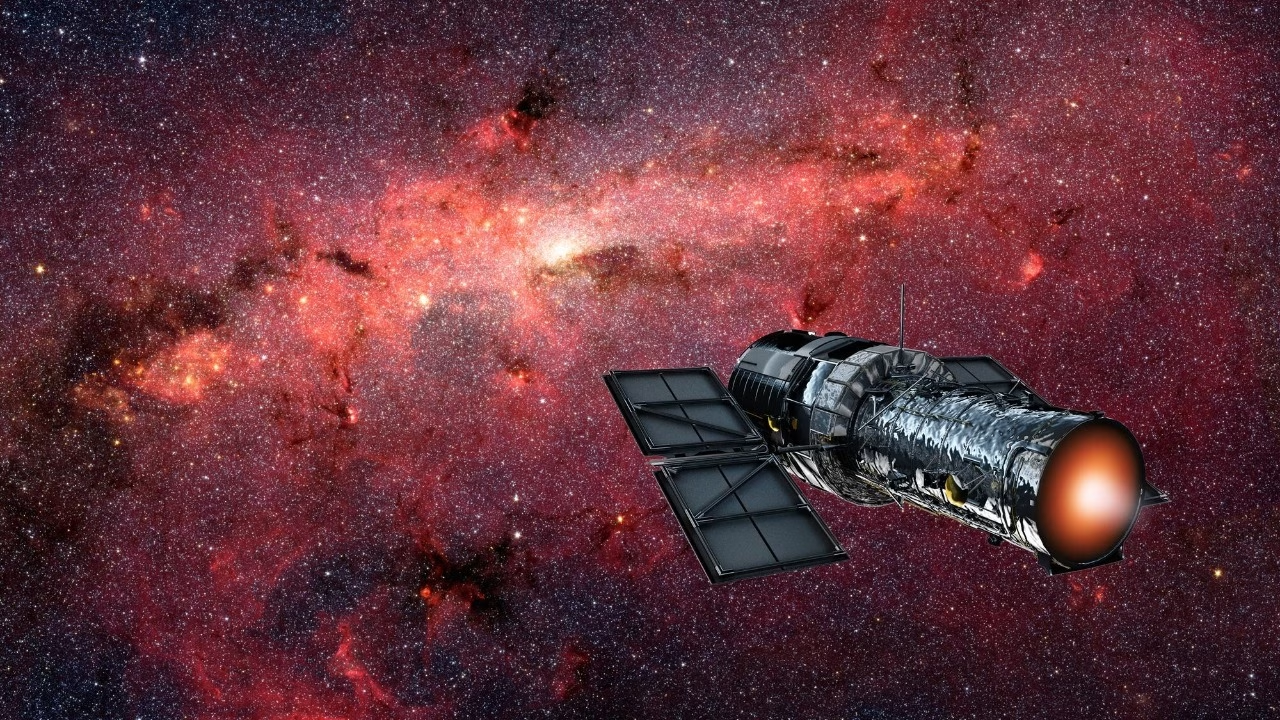
NASA is sounding an unusually stark alarm: in the coming years, streaks from commercial satellites could creep into almost every image taken by major space telescopes. What was once a pristine, black canvas for astronomy is rapidly filling with artificial lights that threaten to turn precision observations into noisy, contaminated data.
The warning is not abstract. Agency researchers now project that planned satellite megaconstellations could disrupt the work of flagship observatories in Earth orbit and beyond, forcing scientists to rethink how they design missions, schedule observations, and even decide which parts of the sky are still worth pointing at.
The new NASA warning: almost every image at risk
When NASA scientists say that almost all space telescope images could soon be affected, they are describing a fundamental shift in how astronomy will work, not a minor nuisance. The agency’s latest analysis concludes that the sheer number of satellites planned for low Earth orbit will leave very few exposures untouched, especially for observatories that stare at large swaths of sky for long periods. That means the default expectation for future missions is no longer a clean frame, but one laced with bright trails that must be detected, modeled, and removed.
In their assessment, researchers explain that the satellites, part of megaconstellations like those operated by private companies, are poised to interfere with both current and upcoming missions. NASA on Wednesday warned that almost all space telescope images could be contaminated by satellite trails and interference, a conclusion tied directly to the rapid growth of commercial fleets in low orbit and the way those spacecraft cross telescope fields of view during long exposures, as detailed in a recent NASA study.
From nuisance to systemic threat: what the numbers show
The scale of the problem becomes clear once I look at the numbers. One analysis finds that planned megaconstellations could contaminate more than 95% of images from some space telescopes, a figure that turns occasional “photobombs” into a near-constant presence. In simulated observations, many of the images taken by wide-field observatories are expected to contain multiple satellite streaks, with some frames showing as many as 92 streaks cutting across a single exposure, according to modeling summarized in a recent Nature report.
These projections sit within a broader warning that satellite swarms are set to photobomb more than 95% of some telescopes’ images, especially those that survey large areas of the sky repeatedly. The same research notes that as operators deploy thousands of additional spacecraft, the probability that any given exposure is clean drops sharply, a trend that is already visible in current data and is expected to accelerate as more constellations come online, as described in the wider satellite contamination analysis.
Why satellites streak and how they ruin data
The physics behind the streaks is straightforward, which is part of what makes the threat so hard to avoid. Satellites reflect sunlight, Earthshine, infrared and radio waves, and when they pass through a telescope’s field of view during an exposure, that reflected and emitted light paints a bright line across the detector. For sensitive instruments designed to pick up faint galaxies, exoplanets, or diffuse gas, even a single trail can overwhelm the signal of interest or introduce subtle artifacts that are difficult to calibrate out, a problem NASA scientists highlight in their discussion of how satellites reflect sunlight and radio waves.
For astronomers, the damage is not just cosmetic. A bright streak can saturate pixels, bleed charge into neighboring regions of a detector, and corrupt the precise measurements of brightness and position that underpin modern cosmology and exoplanet science. When satellite swarms cross the same field repeatedly, they can also leave systematic patterns that mimic or mask real astrophysical structures, which is why NASA researchers warn that the result could be lost scientific information about galaxies, planets, and other targets, a concern echoed in coverage of how satellite swarms are ruining images.
Hubble’s future: from iconic images to 40% ruined frames
Few symbols of modern astronomy are as recognizable as the Hubble Space Telescope, which has orbited Earth since the 1990s. Yet NASA researchers now warn that satellite trails could ruin 40% of Hubble images by 2035 if current deployment plans proceed, a projection that would fundamentally change how often the observatory can deliver the pristine views the public is used to seeing. That 40% figure reflects not just occasional streaks, but a sustained rise in contamination that would force mission planners to discard or heavily process a large fraction of Hubble’s data, as detailed in a recent analysis of how satellite swarms threaten 40% of Hubble images.
The threat is closely linked to the rapid expansion of constellations associated with private operators. The same body of research notes that the threat posed by Elon Musk’s satellites also affects space telescopes like Hubble, with a NASA study predicting that 96% of certain observations could be impacted once the full fleets are in orbit. In that scenario, Hubble’s iconic deep fields and precision measurements of distant galaxies would be increasingly crisscrossed by trails from satellites tied to Elon Musk, a risk that scientists describe in detail when warning that the threat posed by Elon Musk’s satellites also affects Hubble.
New missions in the crosshairs: SPHEREx and European telescopes
The problem is not limited to legacy observatories. NASA’s SPHEREx telescope, a mission designed to map the entire sky in infrared light, is particularly vulnerable because it will scan huge areas repeatedly. Researchers revealed that NASA’s SPHEREx telescope, the European Space Agency’s Euclid mission, and the future European space telescope known as the Nancy Grace Roman Space Telescope could each see a significant fraction of their images affected, with SPHEREx alone projected to have 39.6% of its images impacted by satellite trails, according to the same NASA modeling.
European missions face similar headwinds. Now, a NASA study warns that not even space telescopes like Hubble will be safe from the threat that satellite constellations pose, and it extends that warning to this future European space telescope that aims to probe dark energy and exoplanets. In that work, NASA scientists emphasize that the combination of wide fields, long exposures, and fixed survey strategies makes these observatories especially sensitive to the growing web of satellites, a concern spelled out in their warning that now a NASA study warns about this future European telescope.
Elon Musk’s Starlink and the megaconstellation boom
Behind the statistics is a simple driver: the satellite boom in low Earth orbit, led by megaconstellations that promise global broadband coverage. The satellites, part of megaconstellations like Elon Musk’s Starlink, reflect sunlight and emit light, causing streaks and flares that cut across telescope images and complicate data analysis. As operators race to deploy thousands of spacecraft for communications and navigation, the cumulative effect on astronomy grows, a trend that scientists highlight when describing how Elon Musk’s Starlink could contaminate space telescope images.
NASA’s own scientists have been explicit that the threat is not confined to a single company, but the scale of Elon Musk’s plans makes Starlink a central example. The threat posed by Elon Musk’s satellites also affects space telescopes like Hubble, and NASA researchers warn that 96% of certain observations could be impacted once the full Starlink and similar constellations are deployed. That 96% projection underscores how quickly the balance has shifted from a handful of bright objects to a dense shell of hardware around Earth, a shift that NASA and other agencies now treat as a core constraint on future mission design, as described in their assessment that 96% of observations could be affected.
How scientists measured the “photobomb” problem
To move beyond anecdotes, researchers have started to quantify exactly how often satellites intrude on astronomical images. For this study, scientists selected random locations in space and curated a database of satellite trails, recording information about brightness, length, and frequency to build a statistical picture of the contamination. By combining those measurements with orbital data and telescope pointing strategies, they could estimate how many trails different observatories are likely to see in a typical night, a methodology described in detail in work that explains how scientists selected random locations and tracked satellite trails.
The results show that as more satellites are launched, the number of trails per image rises in a predictable way, which is why projections for the next decade look so stark. Many of the images taken by future wide-field telescopes are expected to contain at least one trail, and some will be riddled with dozens, especially during twilight when satellites are still sunlit while the ground below is dark. That is why researchers now describe satellites as “photobombing” space images, a term that captures both the randomness of individual streaks and the inevitability of their appearance in long exposures, as highlighted in the broader satellite swarms study.
The coming surge: 560,000 satellites and a crowded sky
The projections for contamination are rooted in another staggering figure: the number of satellites humanity is planning to launch. Light from 560,000 satellites that humanity is planning to launch into low Earth orbit is expected to brighten the night sky and increase the background glow that telescopes must peer through. That 560,000 figure, drawn from filings and announced plans, illustrates how quickly the orbital environment is changing from a sparse set of spacecraft to a dense shell of hardware, a shift described in reporting on how a satellite surge threatens space telescopes.
For astronomers, the concern is not just the direct streaks, but the cumulative glow of so many reflective surfaces. As more satellites fill the sky, the average brightness of the night increases, which can wash out faint structures and reduce the contrast that telescopes rely on to detect distant galaxies or subtle gravitational lensing signals. NASA researchers and their collaborators argue that without coordinated mitigation, the combination of direct trails and diffuse brightening could erode the scientific return of some of the most ambitious missions planned for the next decade, a warning that underpins their call to treat the satellite boom as a growing threat to space telescopes, as emphasized in their characterization of the satellite boom as a growing threat.
What mitigation could look like, and why it may not be enough
Faced with these projections, NASA and the broader astronomy community are scrambling to identify ways to limit the damage. Some of the most immediate ideas focus on satellite design, such as darkening surfaces, changing orientations to reduce reflectivity, or adding sunshades that keep the brightest components out of direct sunlight during key observing windows. Others involve operational changes, like adjusting orbits to avoid the most sensitive regions of the sky at certain times, or coordinating with observatories so that satellites maneuver away from critical lines of sight, strategies that scientists discuss when outlining options such as limiting the satellite’s reflectivity and altering flight paths in their analysis of how to limit satellite reflectivity.
On the telescope side, mission teams are exploring more sophisticated software to detect and mask trails, as well as scheduling strategies that avoid the most crowded orbital altitudes during twilight. Yet even the most optimistic scenarios acknowledge that mitigation will only reduce, not eliminate, the problem, especially if the full slate of 560,000 planned satellites is deployed. That is why NASA researchers stress that before these satellites become operational, regulators and operators need to figure out what the consequences will be for telescopes and how to mitigate any problem, a point they underline in their call to address the satellite swarms problem.
More from Bisakimia

- 6 Makanan yang Bisa Menyebabkan Ketombe - December 16, 2025
- Why your microwave might be ruining your food, according to science - December 16, 2025
- Rachmatul Karimah Berbagi Ilmu Melalui Buku - December 16, 2025


Leave a Reply