Planned mega constellations may swamp future orbiting telescopes
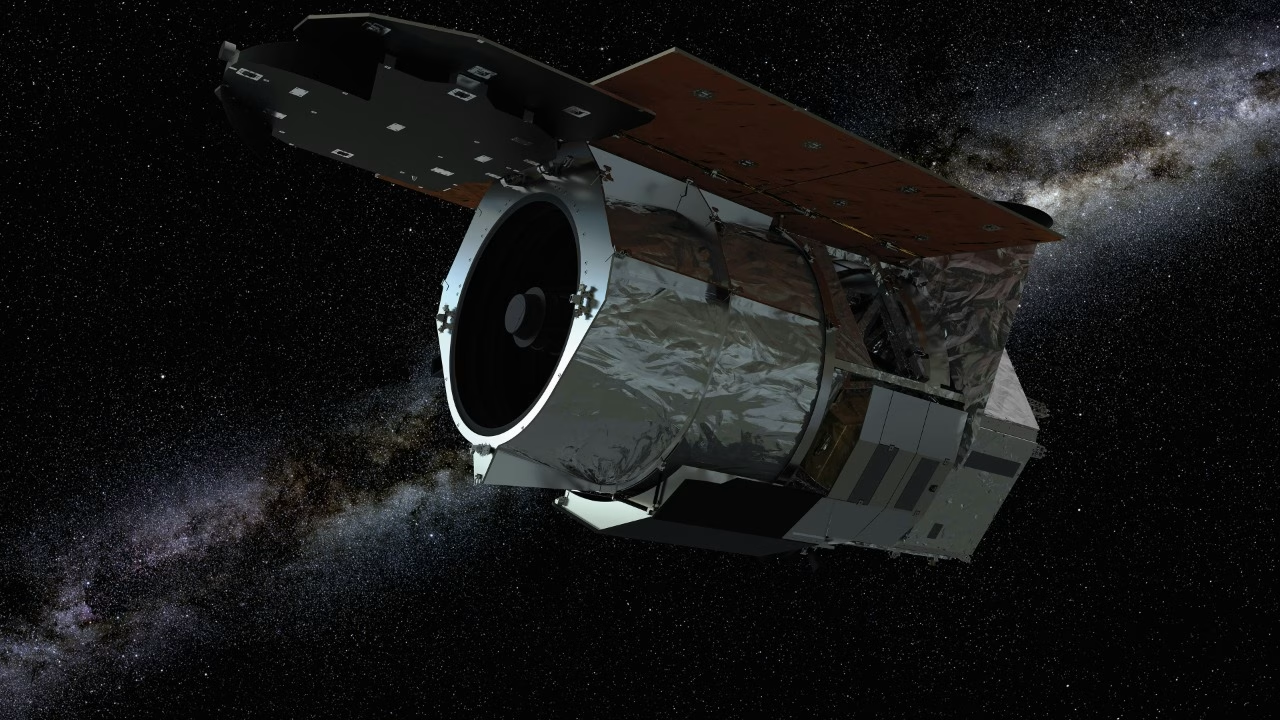
Orbiting observatories were supposed to escape the glow and clutter that plague ground-based astronomy, but the next generation of satellite networks is rapidly erasing that advantage. As commercial operators race to fill low Earth orbit with internet and communications hardware, astronomers warn that the same mega constellations powering global connectivity could overwhelm the very telescopes designed to study the universe in pristine detail.
The stakes are no longer abstract: researchers now project that iconic instruments such as Hubble and future space telescopes could see a large share of their images scarred by satellite streaks, radio noise, and scattered light. The question is shifting from whether these constellations will interfere with space science to how much damage they will do, and how quickly.
The scale of the coming satellite surge
The core problem is simple arithmetic. Astronomers are used to working around a few thousand active satellites, but they are now bracing for a sky populated by hundreds of thousands of bright, moving objects. One analysis of planned systems found that if the full slate of projects goes ahead, roughly 560,000 satellites could be launched into orbit in the coming decade, a figure that dwarfs anything space agencies have managed before.
What makes this surge different is not only the raw number of spacecraft but their concentration in low Earth orbit, where they are both brighter and more likely to cross the fields of view of telescopes. A recent analysis by three astronomers from NASA used detailed simulations of these Planned constellations to show how densely packed shells of spacecraft would intersect with common observing orbits. Their work suggests that without new rules or technical fixes, the sky around popular altitudes will be so crowded that future orbiting telescopes will struggle to find clear lines of sight.
Hubble as an early warning sign
Hubble is already offering a preview of what that future looks like. NASA researchers now estimate that if current launch plans proceed, satellite trails could ruin 40% of the images taken by Hubble by 2035, a staggering hit to one of the most productive observatories in history. That projection is not a distant, theoretical concern, it is rooted in the growing number of streaks already appearing in Hubble’s long exposures as more Satellite constellations pass through its orbit.
Independent work has reached similar conclusions, with a separate study warning that satellite megaconstellations will significantly degrade images from space telescopes such as Hubble. Together, these findings turn Hubble into a canary in the orbital coal mine, showing how even a well established mission in a relatively high orbit is no longer insulated from the traffic below.
Future observatories in the firing line
The impact will not be limited to legacy missions. New observatories are being designed and launched into orbits that were chosen before the current satellite boom fully materialized, and they are now heading into a far more congested environment than their planners anticipated. China’s upcoming Xiuntian space telescope, for example, is expected to fly roughly 250 miles (400 kilometers) above Earth, an altitude that places it squarely among the densest shells of communications satellites.
At the same time, astronomers are drawing a sharp distinction between different classes of missions. The James Webb Space Telescope and NASA’s next major observatory, the Nancy Grace Roman Space Telescope, operate or will operate far from low Earth orbit, which shields them from the worst of the visual clutter. But the same reporting notes that Satellites Swarming Low Earth Orbit Threaten Space Telescopes that share their altitude, and that proliferating constellations are already beginning to harm the science that can be done from those platforms by the end of the 2030s.
Optical scars: bright trails and lost data
For optical astronomy, the most visible symptom of the mega constellation era is the bright streak that cuts across a carefully composed image. Reflections from satellites can be visible to the unaided eye and extremely bright for professional telescopes, with Reflections measured at levels that overwhelm faint galaxies and subtle structures. When a satellite passes through a long exposure, it can saturate pixels, leave residual artifacts, and force astronomers to discard or painstakingly repair the data.
Researchers working with Hubble and other instruments have learned that some of this damage can be mitigated, but only at a cost. If the observations can be repeated or combined, it is possible to partially correct the data, though not without some loss of information and extra work for already stretched teams, as one scientist explained in a detailed account of how If the satellite trails from Elon Musk’s networks are affecting space telescopes like Hubble. The more crowded the sky becomes, the less practical it is to simply reobserve every ruined frame.
Radio noise and the “quiet sky” problem
The threat is not confined to visible light. Many of the planned constellations rely on powerful radio transmitters that can spill energy into frequencies used by radio astronomers, turning once quiet parts of the spectrum into a noisy backdrop. The same study that projected up to 560,000 satellites also calculated how their combined electromagnetic radiation in low frequencies would raise the background level for sensitive instruments, making it harder to detect faint cosmic signals.
Recognizing that the problem now extends above the atmosphere, the International Astronomical Union has launched the Centre for the Protection of the Dark and Quiet Sk to coordinate responses to both optical and radio interference. The group’s message is blunt: low Earth orbit space telescopes are getting blocked by internet satellites, and the time to act is now if astronomers hope to preserve access to the dark and quiet sky that underpins both ground based and orbital science.
Why space telescopes are no longer safe havens
For decades, astronomers reassured themselves that if light pollution and atmospheric turbulence made ground based observing harder, they could always retreat to orbit. That assumption is now breaking down. One researcher summed up the shift by noting that “That’s why we put things on mountains. And we thought space was above all the disturbances, and it turns out that depending on what you are looking at, it is not,” a reflection captured in reporting on how launching hundreds of thousands of satellites will threaten space based astronomy.
Other astronomers have warned that Satellites Swarming Low Earth Orbit Threaten Space Telescopes by creating a new layer of interference that sits between Earth and the deep universe. As one detailed feature on Earth Orbit Threaten Space Telescopes put it, proliferating spacecraft are beginning to harm the science that can be done from orbit, and that harm is expected to grow steadily through the end of the 2030s unless launch plans change.
Scientific stakes: from cosmology to planetary defense
The loss of clean images is not just an aesthetic problem, it cuts into some of the most ambitious projects in modern astronomy. A report from the American Astronomical Society concluded that satellite mega constellations will fundamentally change astronomical observations for optical and near infrared investigations moving forward, affecting everything from dark energy surveys to the hunt for the first galaxies. When a significant fraction of exposures are compromised, large statistical programs that rely on uniform, deep imaging become harder to execute and more expensive in telescope time.
There are also more immediate concerns. Astronomers who search for near Earth objects warn that bright trails can hide or mimic the faint signatures of asteroids, complicating efforts to spot potential threats. One scientist described how, while space based telescopes may be able to repeat some observations, it is not the case all the time, especially when tracking a fast moving new asteroid, a point highlighted in coverage that invited viewers to WATCH a Proposed satellite constellation’s impact on such work. In planetary defense, a missed detection can have consequences far beyond the scientific community.
Industry responses and their limits
Satellite operators are not ignoring the backlash. Some major commercial space companies have begun experimenting with darker coatings, sunshades, and adjusted orbits in an effort to reduce their impact on astronomy. These Voluntary efforts have shown that it is possible to dim satellites and tweak their behavior, but the problem is far from solved, especially as new entrants plan their own fleets without a binding global standard.
Scientists working on Hubble and other missions are also developing software tools to identify and mask satellite trails, and they are rethinking observing strategies to avoid the busiest orbital corridors when possible. Yet even optimistic assessments concede that more than half a million satellites are Planned, and that More launches could ruin Hubble Space Telescope images if nothing changes. Technical fixes can buy time and reduce the worst effects, but they cannot fully compensate for a sky that is simply too crowded.
Rethinking our relationship with the night sky
Behind the technical debates lies a deeper question about how humanity values the night sky as a shared resource. Some astronomers and philosophers of science argue that the ability to see distant galaxies and measure faint starlight is not just a professional concern but part of a broader cultural heritage. That perspective has even seeped into unexpected corners of public discourse, where discussions of Attempted Solutions In creation astronomy wrestle with how distant light reaches Earth and what it tells us about the age and structure of the universe.
As I weigh the evidence from Dec reports and the warnings from NASA scientists, I see a clear pattern: the benefits of global connectivity are being pursued with little regard for the long term health of orbital science. The threat posed by Elon Musk’s satellites and other mega constellations is no longer just a ground based nuisance, it also affects space telescopes like Hubble Space Telescope and future missions that have not yet left the launch pad. Unless regulators, industry, and the scientific community find a way to balance commercial ambition with cosmic curiosity, the next generation of orbiting observatories may spend more time dodging satellites than studying the stars.
More from Bisakimia

- 6 Makanan yang Bisa Menyebabkan Ketombe - December 16, 2025
- Why your microwave might be ruining your food, according to science - December 16, 2025
- Rachmatul Karimah Berbagi Ilmu Melalui Buku - December 16, 2025


Leave a Reply