Ancient humans in southern Africa isolated ~100,000 yrs, genes extreme
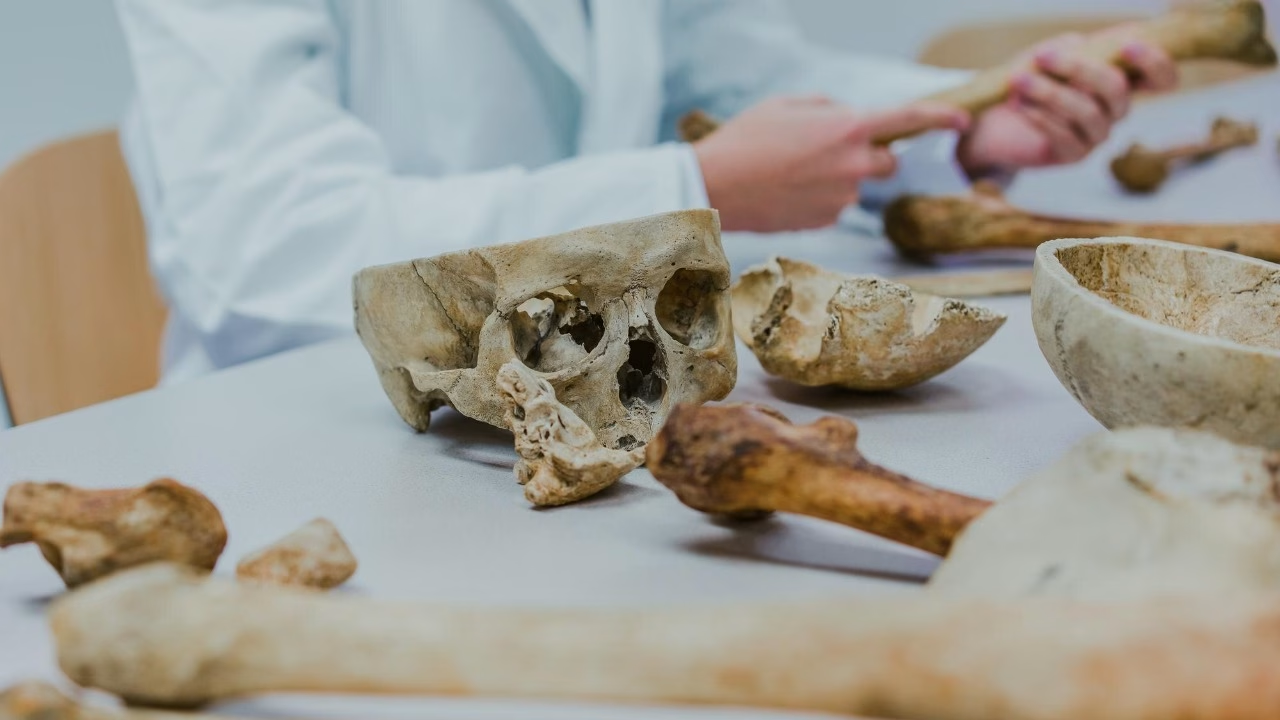
Ancient DNA from southern Africa is rewriting the story of our species, revealing that some early humans in this region lived in deep isolation for roughly 100,000 years and evolved genetic patterns that sit at the very edge of what scientists have seen in Homo sapiens. Instead of a single, smoothly mixing ancestral population, the new evidence points to a patchwork of long separated groups whose descendants still carry echoes of that extreme diversity in their genomes today.
By tracing these genetic fingerprints across thousands of years, researchers are uncovering how isolation, climate shifts and later migrations combined to shape both the people of southern Africa and the wider human family. The result is a more complex, and far more interesting, picture of human evolution than the tidy diagrams that once dominated textbooks.
Ancient DNA that stretches our map of human evolution
When I look at the new genetic data from southern Africa, what stands out first is how far back it pushes the timeline of population structure in our species. Instead of a late, shallow branching, the genomes suggest that a group of people in this region remained partly cut off from other humans for hundreds of thousands of years, long enough for their DNA to drift in a distinct direction. That kind of separation implies that early Homo sapiens were already splitting into regional populations while stone tools and fossils still looked broadly similar.
The scale of this work is striking, because the study is based on ancient genomes from individuals who lived thousands of years ago, including people whose remains are roughly 10,000 years old, and it shows that this long standing separation in southern Africa left a clear genetic imprint. By anchoring modern DNA patterns to these ancient reference points, researchers can see that the divergence between southern groups and other Africans began far earlier than many models assumed, and that later contacts did not fully erase that deep history.
Isolation for 100,000 years and what it really means
The headline figure that has captured attention is that some ancient African populations appear to have been isolated for about 100,000 years, a span long enough to cover multiple ice ages and major environmental swings. In population genetics terms, that does not mean absolute separation with zero contact, but it does point to very limited gene flow, so that most marriages and births occurred within the same regional group over countless generations. That kind of semi isolation is exactly the condition under which subtle genetic differences can accumulate and eventually become profound.
Researchers describe this as a mystery of isolation because it raises hard questions about how geography, climate and behavior could sustain such a long period of separation inside a single continent. The new analysis of Ancient African Populations Were Isolated for roughly 100,000 Years, And Their Genetics Are Completely Different, argues that this deep split is not a minor footnote but a central feature of how Homo sapiens diversified within Africa, and it cautions that any simple, single origin story misses the complexity revealed in the DNA.
Southern Africa’s people at the extreme end of variation
What makes these ancient genomes so startling is not only their age but where they fall on the spectrum of human diversity. When scientists compared the DNA of individuals from southern Africa who lived between about 10,200 and 1,400 years ago with a wide panel of modern populations, many of those ancient people did not slot neatly into any known cluster. Instead, they landed at what the researchers called an extreme end of human genetic variation, a position that stretches the boundaries of how different two groups of Homo sapiens can be while still belonging to the same species.
In practical terms, that means that the genetic distance between some of these ancient southern Africans and other humans rivals or exceeds the gaps seen between far flung modern populations today. The team found that Many of the ancient Africans, including those who lived between about 10,200 and 1,400 years ago, fall outside the variation of present day groups, which underscores how much diversity has been lost or blended away over time as migrations and mixing smoothed out some of the sharpest edges in our genetic landscape.
The San and the living legacy of deep time
To understand the human story behind these numbers, I keep coming back to the Indigenous communities whose ancestors contributed many of these ancient genomes. The San, also known as Saan or Bushmen, are among the oldest continuous hunter gatherer cultures in the world, and they have long lived across parts of Botswana, Namibia, Angola, Zimbabwe, Lesotho and South Africa. Their languages, rich in click consonants, and their mobile way of life reflect adaptations to some of the most challenging environments on the continent.
Genetic studies have repeatedly shown that the San peoples carry lineages that branch very deeply on the human family tree, and the new ancient DNA work reinforces that picture by tying specific ancient individuals to the broader history of these communities. When scientists say that some southern Africans sit at an extreme end of human genetic variation, they are not talking about an abstract cluster on a chart, but about the living descendants of hunter gatherers whose ancestors weathered tens of thousands of years of isolation and environmental change in Africa.
How 100,000 years of separation reshaped ancient genomes
From a genetic perspective, a separation lasting around 100,000 years is long enough to reshape entire sections of the genome through drift, local adaptation and the random sorting of ancestral variants. In a relatively small, semi isolated population, rare mutations can become common simply by chance, while other variants disappear, gradually carving out a unique genetic profile. Over such a long span, even modest differences in diet, pathogens or climate can further tilt the balance, favoring certain immune genes or metabolic traits that might be neutral or even disadvantageous elsewhere.
The new work on ancient southern African humans argues that this is exactly what happened when groups in the region experienced limited gene flow from other populations for nearly 100,000 years. According to the analysis of Ancient Southern African humans, this prolonged isolation in Africa led to unique genetic signatures that are not easily explained by later mixing, and it helps clarify why some ancient individuals fall so far from the clusters defined by present day populations.
Revisiting the “single cradle” idea of human origins
For decades, popular accounts of human evolution leaned on a simple image of a single cradle of modern humans somewhere in Africa, followed by a clean expansion outward. The new southern African genomes make that picture look far too tidy. Instead of one ancestral population radiating in all directions, the data point to multiple, long separated groups within Africa itself, some of which, like the southern cluster, remained partly isolated for around 100,000 years before later waves of contact blurred the boundaries.
By showing that a group in southern Africa lived in partial isolation for hundreds of thousands of years, the ancient DNA study from Dec forces a rethink of how and when key traits of modern humans emerged. It suggests that features like complex language, symbolic behavior or particular anatomical details may have arisen in overlapping waves across different African populations, rather than in a single, tightly defined group, and that later mixing stitched these regional innovations together into the broader Homo sapiens package we recognize today.
Climate, landscape and the mechanics of isolation
To make sense of such long lasting separation within one continent, I find it useful to picture the shifting climate and landscapes that early humans faced. During cooler, drier phases, deserts and arid zones would have expanded, turning what are now passable regions into formidable barriers for small foraging bands. Rivers and lakes that once served as corridors could shrink or vanish, while dense forests or rugged highlands might isolate pockets of people who had adapted to those specific niches.
In southern Africa, these environmental filters likely combined with cultural choices to limit contact between groups, even when absolute distance was not enormous. The evidence that ancient populations in this region remained partly isolated for roughly 100,000 years suggests that such barriers were not temporary glitches but recurring features of the landscape. Over time, those constraints on movement and marriage would have amplified genetic differences, helping to create the extreme variation now visible in the genomes of ancient and modern people from Africa’s southern tip.
What “completely different” genetics means for medicine
When scientists describe the genetics of these ancient populations as “completely different,” they are not claiming that these people were a separate species, but they are signaling that the usual reference panels used in medical genetics barely capture their diversity. For modern medicine, that gap matters. If contemporary descendants of these groups still carry distinctive variants in immune genes, metabolism or drug processing pathways, then health studies that rely mostly on European or even pan African averages will miss crucial risk factors and protective traits.
The analysis that framed these ancient African populations as having genetics that are completely different from other groups highlights how much work remains to build inclusive genomic databases. By treating the roughly 100,000 years of isolation as a central feature rather than an oddity, the study of Years, And Their Genetics Are Completely Different underscores that precision medicine will only live up to its promise if it accounts for the full range of human variation, including lineages that sit at the extreme ends of the spectrum.
Why this deep history matters for identity and science
Beyond the technical details, I see a profound human story in the realization that some communities in southern Africa carry a genetic legacy shaped by around 100,000 years of semi isolation. For people who identify with these lineages, the new findings can affirm a sense of deep time belonging to particular landscapes, while also connecting them to a broader, pan African web of ancestry that has been braided and re braided by later migrations. It is a reminder that modern identities, whether framed as ethnic, national or cultural, sit atop a far older and more fluid history of movement and mixture.
For science, the lesson is equally clear. Each time researchers add ancient genomes from underrepresented regions like southern Africa, the human story becomes more intricate and more accurate. The discovery that many ancient southern Africans, including those who lived between about 10,200 and 1,400 years ago, fall at an extreme end of human genetic variation, as shown in the study of Africans, is not an outlier to be filed away, but a signal that our models must stretch to accommodate the full breadth of who we are and where we come from.
More from Bisakimia

- 6 Makanan yang Bisa Menyebabkan Ketombe - December 16, 2025
- Why your microwave might be ruining your food, according to science - December 16, 2025
- Rachmatul Karimah Berbagi Ilmu Melalui Buku - December 16, 2025


Leave a Reply